/59748.tmb-300v.png?sfvrsn=9885965b_2 "For the future - publication thumbnail")

A nine-member emergency health response team was deployed to Western Province for a 14-day mission to support the ongoing response efforts in affected communities, particularly around Gizo, in the aftermath of the widespread destruction caused by Cyclone Maila.
Solomon Islands Medical Assistance Team (SolMAT) team leader Dr Janella Solomon confirmed that the deployment will bolster frontline health services and ensure critical coordination between field operations and national authorities.
“Our role is to complement the existing teams on the ground,” Dr Solomon said. “We will be working closely with the Provincial Health Emergency Operations Center, and the staff at Gizo Hospital, gathering real-time information, and reporting back to the Ministry of Health and Medical Services (MHMS) and the National Health Emergency Operations Center in Honiara.”
/countries/solomon-islands/drjanella.jpg?sfvrsn=d2f190b7_3 "drjanella")
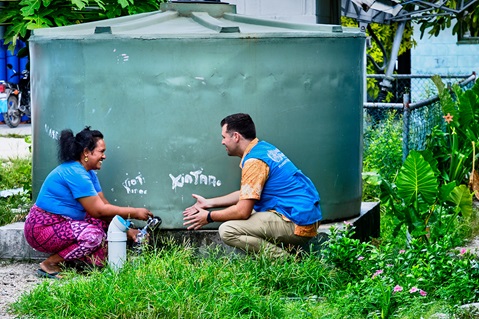
Dr Janella Solomon explains the role of the SolMAT team to Ruel Serrano, WHO Solomon Islands Communications for Partnerships Support Officer. Photo: WHO / Esther Nuria
Dr Janella Solomon explains the role of the SolMAT team to Ruel Serrano, WHO Solomon Islands Communications for Partnerships Support Officer. Photo: WHO / Esther Nuria
The deployment follows urgent requests from the Western Provincial Health Directorate for additional human resources across both public health and clinical services. Current reports highlight the need for medical supplies, technical expertise, and essential resources, alongside emerging health concerns, including reports of children with diarrhoea on one of the islands near Gizo.
The multidisciplinary team brings expertise in logistics, risk communication, water, sanitation, and hygiene, clinical care, pharmacy, nursing, and administration—allowing for a comprehensive and flexible response.
“As trained emergency responders, we are equipped to address a wide range of needs—not just clinical care, but also sanitation, public health, and coordination efforts,” Dr Solomon explained. “We will also work alongside NGOs already operating in the area to ensure a unified and effective response.”
/countries/solomon-islands/img_7960.jpg?sfvrsn=b147ad65_3 "IMG_7960")
The team prepares to embark on a 14-day mission. Photo: WHO / Ruel Serrano
The team prepares to embark on a 14-day mission. Photo: WHO / Ruel Serrano
The deployment is supported by MHMS, including key partners including the governments of Australia and New Zealand, and international organizations such as the World Health Organization (WHO), which, since 2018, has supported the establishment of Emergency Medical Teams (EMT)at the national and provincial levels, and the procurement of the deployment cache.
A WHO EMT deployment cache is a standardized package of essential medical equipment, supplies, and logistics gear designed for rapid deployment, enabling teams to remain self-sufficient for at least 3 days. These caches enable national EMTs in the Pacific to provide high-quality care, including tents, water treatment, and medicines, without straining local resources.
Last year, the MHMS and WHO initiated the setting up of provincial EMTs in Western Province as part of their preparedness to respond to all-hazard emergencies. These contributions, ranging from training and logistics to transport and communication, have been critical in enabling rapid response efforts.
WHO, through its global EMT initiative, has been instrumental in building the capacity of Solomon Islands’ emergency responders through the SolMAT. The EMT initiative improves the timeliness and quality of health services provided by national and international EMTs and enhances the capacity of national health systems in leading the activation and coordination of rapid response capacities in the immediate aftermath of a disaster, outbreak, and/or other emergency.
Dr Solomon expressed gratitude for this collaboration, noting that “such partnerships are essential. We could not carry out this mission without the continued support of our partners and stakeholders.”
Dr Solomon also shared a heartfelt message to communities impacted by the current crisis: “Remain strong and courageous. Our people are resilient, but resilience does not mean facing challenges alone. We are coming to work together with you—to support, rebuild, and overcome this situation side by side,” she said.
The team is expected to assess conditions on arrival and provide ongoing updates to inform further national response efforts.